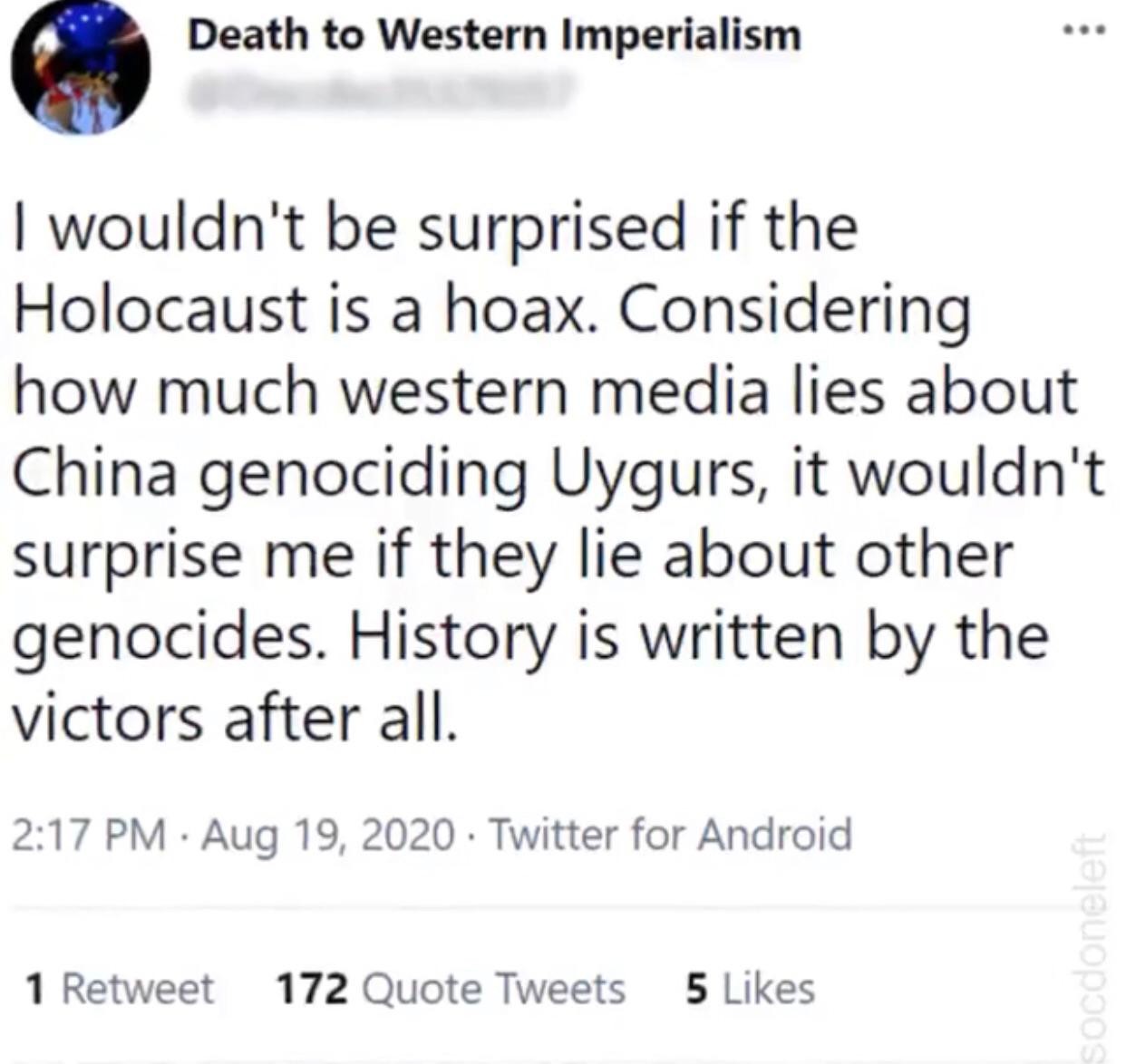
I mean, sure about the victors part. If the chinese don’t want to be accused of doing genocide they shouldn’t have lost a little thing called WWII. Fuck them.
China was on the Allies side…
No chinaman is my ally. I take them as lovers.
what

Funny enough, I can’t think of a single historical narrative where that’s true. Even the most nationalist narratives include a great deal of gnashing of teeth over ‘unjust’ defeats which MUST BE AVENGED.
I mean, even Germany itself acknowledges it soo
Don’t you understand?! They are just CIA/NATO puppets!!! Psyop! Everything I don’t like, or anything published by the west is a psyop against us innocent teenage edgelord militant leninist. Boo hoo. /s
Like MAGA, they’re always the victims. Like MAGA, they’ve done the research and question the Holocaust. God forbid a western source discuss the Armenian genocide or they might question it too. Cultural genocide of uhyger and Tibetan population? Totally not happening bro. China says no don’t question it.
You couldn’t convince me they and MAGA don’t share a mental illness.
You couldn’t convince me they and MAGA don’t share a mental illness.
Tribalism. The measles of mankind, to paraphrase Einstein.
More or less yup. That and mindless reflexive reactionary behavior.
You don’t need to throw tribes under the bus, you can call it sectarianism.
Tribes were actually pretty good at coexistence. Here in Australia before colonisation, tribes went to war sometimes, and often, nobody died. They had rules for how to conduct war that made it safe. Nations are way more violent than tribes.
That doesn’t really gel with the observation of high per capita rates of death by violence in hunter-gatherer societies.
https://international-review.icrc.org/articles/indigenous-australian-laws-of-war-914

Despite the quarrels of the past, we have finally – partly through Darmangeat’s work – arrived at a basic idea of the two main types of inter-tribal confrontation that occurred in Indigenous Australia. The most common, devastating warfare seems to have been stealth attacks – raids or kanudaitji (secret or revenge expeditions), for instance in the Western Deserts.40 These were usually small parties of men, but sometimes scores or more, who would sneak deep into enemy territories to commit assassinations or theft (usually of women).41 In contrast to raids there existed what we can call open, regulated battles (some prefer the word “tournaments”), which were much more formalized and lengthy events, involving anywhere from 60 to over 1,500 combatants, drawn from several allied groups.
…
At any rate, battles, raids and duels were intended more as a form of cathartic venting rather than a field of slaughter. In South Australia, an Indigenous Australian informant described what he considered a recent “glorious” (successful) battle. He defined it as successful because “nobody tumble down, only big one yabber [talk]. … My king … say ‘don’t throw spears, only yabber.’”
Even when battles involved very large numbers of warriors, they generally resulted in flesh wounds and very few, if any, deaths – although there were some very violent exceptions, depending on the intensity of the dispute. Raids were more usually fatal, and highly unpredictable (indeed, it was expected that women and children would suffer), but often only the targets were slain.
According to his findings, 64% of open battles ended with less than three deaths each, despite usually involving hundreds of combatants.
… that’s not at all unusual. Even with technology and tactics as late as the 15th century AD, battles of thousands of individuals could end with only a handful of actual deaths. Hand-to-hand combat is extremely trying, and without a means of running down an enemy after they’re routed (ie cavalry), casualties only become large in the most desperate and dire of battles.
None of that paper seems to at all address my point, which was of per capita deaths by violence, not whether any individual battle produced a large number of deaths.
That history comes from evidence from the loser’s own records of doing it.